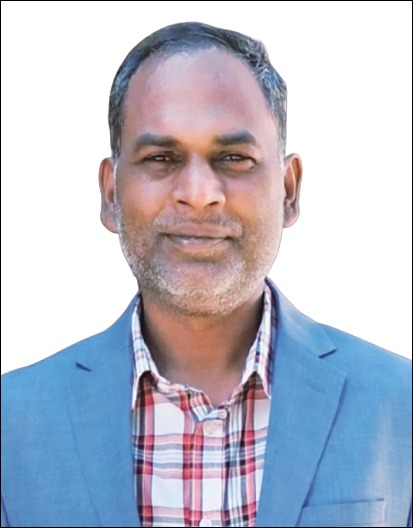
Our Team
Leadership
Guided by experienced researchers and visionaries in interdisciplinary materials science


The future of materials is written in the language of quantum mechanics. At CRITMS, we explore that language through the lens of condensed matter physics, where curiosity meets rigor and understanding inspires discovery. We believe that understanding emergent quantum phenomena in materials lays the theoretical foundation for tomorrow's technologies.
CRITMS is a Chattogram-based independent research institute dedicated to advancing materials science through first-principles investigations of low-dimensional materials and quantum-confined systems. As Bangladesh's first independent research institute dedicated to quantum and nanomaterials research, CRITMS represents a new initiative to strengthen Bangladesh's contribution to cutting-edge research in this field. In addition to its research activities, CRITMS seeks to build a vibrant scientific community by providing academic mentorship and research support for doctoral, master's, and undergraduate students. Through computational research, interdisciplinary collaboration, and scientific communication, we support the development of independent researchers equipped to contribute to the global scientific community through high-quality theses, publications, conferences, and collaborative research. Our goal is to lay the foundation for future electronics, energy, and quantum technologies through the discovery and design of new materials.
Applying first-principles quantum mechanical methods to understand and predict material properties at the atomic scale.
Leveraging high-performance computing and machine learning for accelerated materials discovery and screening.
Translating theoretical insights into practical solutions for energy, catalysis, electronics, and environmental challenges.
Providing mentorship and resources for doctoral, master's, and undergraduate theses, publications, and research projects.
Four interconnected pillars spanning the frontiers of theoretical materials science, unified by first-principles computational approaches.
State-of-the-art computational and theoretical approaches driving our research.
First-principles electronic structure calculations for predicting material properties with quantum mechanical accuracy.
Non-equilibrium Green's Function (NEGF) and Landauer formalism for modeling electronic and spin transport in nanoscale materials and devices.
Advanced electronic structure techniques including GW, Bethe-Salpeter equation, and coupled-cluster approaches.
High-level ab initio and post-Hartree-Fock methods for precise molecular and materials characterization.
Classical and ab initio molecular dynamics simulations for studying atomic-scale dynamics and thermodynamics.
AI-driven materials discovery using neural networks, Gaussian processes, and graph-based models.
Data-driven materials science integrating databases, statistical learning, and multiscale simulations to bridge atomistic and continuum descriptions.
Analysis and modeling of μSR experiments using Mantid for investigating magnetic, superconducting, and quantum materials.
Guided by experienced researchers and visionaries in interdisciplinary materials science
Peer-reviewed contributions and academic mentorship advancing the field of theoretical materials science.
Journal of Materials Chemistry C
Physical Chemistry Chemical Physics
Nanoscale
Materials Advances
Alexandria Engineering Journal
Physica Scripta
Interested in collaborating, pursuing research, or learning more about CRITMS? Reach out to us.
5555/6213, Hillview Housing Society, Chattogram-4209, Bangladesh